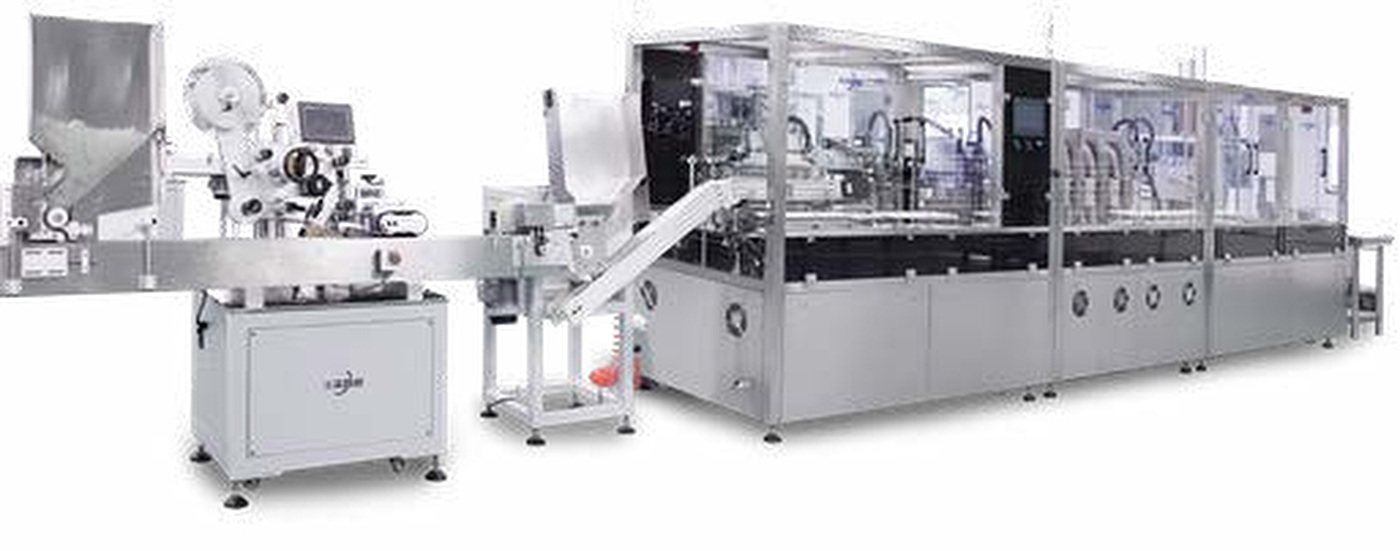
The short answer
A combined coagulant and anticoagulant vacuum blood collection tube line runs stably at 16,000-20,000 tubes per hour with two operators. Tubes of 13mm×75mm and 13mm×100mm are both supported, in PET and glass.
Three stages that decide the output
1. Labeling and inspection
Labeling accuracy is ±0.5mm (excluding label material error) at ≥22,000 tubes/hour, which leaves headroom so labeling never becomes the bottleneck. A labeling CCD station rejects tubes with missing labels.
2. Spraying and filling
Coagulant spraying uses five heads at 10-35µL with ±5% accuracy (20µL basis). Anticoagulant spraying uses five heads at 5-45µL, also ±5%. Sodium citrate filling uses five heads at 60-600µL with ±5µL accuracy. Parallel stations are what create the throughput, and the coagulant station is interlocked with the drying station so reagent cannot run to the bottom of the tube during a long stop.
3. Capping and vacuum plugging
The vacuum chamber uses uniform-pressure technology with servo proportional valve control. The vacuum value is set on the touch screen between -99.9kPa and 0. The CNC vacuum control system samples the chamber, compares the reading with the set point and balances the vacuum until the stopper is seated. This step decides the real cycle time of the whole line.
Line specifications
- Dimensions: 9m × 2.2m × 2.2m (including vibratory bowls and labeling machine)
- Power supply and power: 380V / 50Hz, 25kW
- Clean compressed air: 0.6-0.8MPa, consumption <600L/min
- Weight 2,000kg; noise ≤75dB
Common questions
Why is the output a range rather than a single figure? It depends on the reagent and the vacuum setting. Different additives have different viscosity and drying requirements, so the real cycle time varies. A range is closer to real production.
Can I run only anticoagulant tubes or only coagulant tubes? Yes. The anticoagulation line is 7.5m×2.2m×2.2m at 8kW; the coagulation line is 9m×2.2m×2.2m at 22kW.